

Many retirees assume that Social Security benefits come back tax-free after decades of payroll contributions. But that’s not always the case. Whether any of your benefits are subject to federal income tax, and how much, depends not on your benefit amount alone but on a calculation that pulls in income from other sources. Understanding how that calculation works can clarify decisions you might not realize are connected to your Social Security tax bill.
A Number Called Provisional Income
The IRS uses a measure called provisional income (also referred to in some guidance as combined income) to determine how much of your Social Security benefit enters your taxable income. The formula is set by Section 86 of the Internal Revenue Code and has three parts:
Adjusted gross income, excluding Social Security
Tax-exempt interest income
50% of your Social Security benefits for the year
That total is your provisional income. It gets compared against fixed thresholds to determine how much of your benefit, if any, is subject to tax.
The Thresholds
The thresholds under current law have not changed in decades. The table below shows how they apply by filing status.
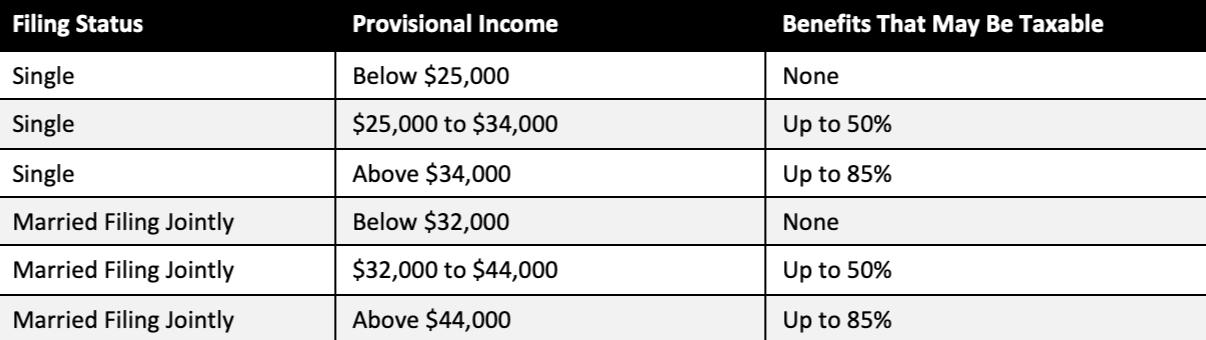
Source: IRS Publication 915 (2025). IRC §86.
A few clarifications are worth noting. "Up to 85%" is a cap, not a flat rate. It means that, at most, 85% of your benefit amount can be pulled into taxable income, where it is then taxed at your ordinary income tax rate. The actual percentage depends on where your provisional income falls within the tier.
Married couples who file separately but lived together during the year face a stricter rule. Their base amount is effectively $0, which means up to 85% of benefits can be taxable from the first dollar of provisional income.
Because the thresholds are not indexed for inflation, many retirees cross them each year even when their real financial circumstances have not changed. Cost-of-living adjustments to Social Security benefits raise the benefit amount, which raises 50% of Social Security in the formula, and that alone can push provisional income upward year over year.
One note on recent news: The One Big Beautiful Bill Act, signed in July 2025, added a temporary per-person deduction for taxpayers age 65 and older, available for tax years 2025 through 2028. The deduction is $6,000 per eligible individual and $12,000 total for a married couple where both spouses qualify. It begins to phase out for taxpayers with modified adjusted gross income over $75,000 ($150,000 for joint filers) and is eliminated entirely at $175,000 or $250,000, respectively.
For eligible retirees, the deduction reduces overall taxable income, which can lower the total tax owed, including on the taxable portion of Social Security benefits. It does not change the provisional income formula, the thresholds, or what counts as income in the calculation.
What Counts, and What Does Not
The composition of your retirement income matters as much as the total. The adjusted gross income portion of the formula includes most common retirement income sources: withdrawals from traditional IRAs and 401(k)s, pension payments, wages, and investment income such as dividends, interest, and capital gains.
Tax-exempt municipal bond interest also enters the calculation, and this tends to surprise people. Municipal bonds generate interest that is federally tax-free for ordinary income purposes, but that interest is added into provisional income. Retirees who hold municipal bonds to reduce their tax exposure may find that the bonds are contributing to the taxable portion of their Social Security benefits rather than working against it.
Qualified distributions from a Roth IRA do not enter adjusted gross income. They are invisible to the provisional income formula. The same is true for a qualified charitable distribution (QCD), which is discussed below. That distribution is excluded from gross income entirely, so it never enters the provisional income calculation. This distinction can carry planning implications when deciding which accounts to draw from in retirement.
Louisiana Residents Have One Advantage
For retirees in Louisiana, the federal calculation is the one to focus on. Louisiana does not tax Social Security benefits at the state level. Under R.S. 47:44.2, any Social Security income that is taxable on your federal return can be excluded from Louisiana taxable income. The state's flat 3% income tax rate applies to other qualifying retirement income from sources such as IRA withdrawals and private pensions, but your Social Security benefit is not in that number.
What You Can Do
Knowing the formula helps create planning options. For example, Roth conversions done before Social Security begins can reduce future provisional income. When you convert traditional IRA funds to Roth in lower-income years, those dollars get taxed at conversion. Qualified Roth withdrawals in later years do not enter provisional income, which can reduce how much of your benefit is subject to tax.
Qualified charitable distributions are worth considering if you are age 70½ or older, hold a traditional IRA, and give to qualified charities. A QCD allows you to direct up to $111,000 per person (the 2026 annual limit) directly from an IRA to a qualifying charity. The distribution counts toward your required minimum distribution (RMD) but is excluded from adjusted gross income, so it does not affect provisional income.
Timing matters as well. In the years before Social Security begins and before RMDs start, there may be an opportunity to draw from traditional accounts while income is lower. That reduces the future RMD base. Once distributions become mandatory, provisional income often rises regardless of other choices.
If you hold municipal bonds or are considering them, running the full provisional income calculation first is worthwhile. The interest may enter the formula in ways that partially offset the tax advantage of holding them.
A Good Place to Start
Social Security taxation is one of several points where retirement income sources interact in ways that are not always obvious from the outside. If you are approaching retirement and have questions about how your income picture fits together, we would be glad to talk through it with you as part of our comprehensive wealth management services.
Schedule a complimentary call with our team at hassellwealth.com or by calling (985) 868-9881.