

Most people preparing for Medicare spend time comparing plan types, understanding coverage options, and figuring out when to enroll. Fewer take time to understand what their income has to do with what they’ll actually pay. For retirees above certain income levels, that’s a gap worth closing.
Medicare Part B and Part D premiums aren’t the same for everyone. A surcharge called IRMAA can add significantly to your monthly costs, and it’s triggered by income reported to the IRS, not by the plan you select. Understanding how it works is a useful part of any retirement income plan.
What Is IRMAA?
IRMAA stands for “income-related monthly adjustment amount.” It’s a surcharge added to standard Medicare Part B and Part D premiums for beneficiaries whose modified adjusted gross income (MAGI) exceeds IRS-defined thresholds.
The Social Security Administration (SSA) determines whether you owe a surcharge based on your federal tax return from two years prior. For 2026, that means the SSA is looking at your 2024 return.
The Two-Year Lookback
The two-year lag is one of the most important things to understand about IRMAA. A retiree who stepped away from work in 2025 with a significantly lower income may still owe the surcharge in 2026 if their 2024 MAGI was above the threshold.
Similarly, income decisions you make today, including Roth conversions, real estate sales, or large withdrawals, can affect your Medicare costs two years from now.
How the Brackets Work
IRMAA operates as a cliff system, not a gradual scale. If your MAGI crosses into the next bracket by a single dollar, you pay the full surcharge for that tier for the entire year.
For 2026, the surcharge begins for single filers with MAGI above $109,000, and for married couples filing jointly with MAGI above $218,000. There are five tiers for each. Note that these are per-person premiums, so married couples where both spouses are on Medicare pay each amount twice.
Single Filers
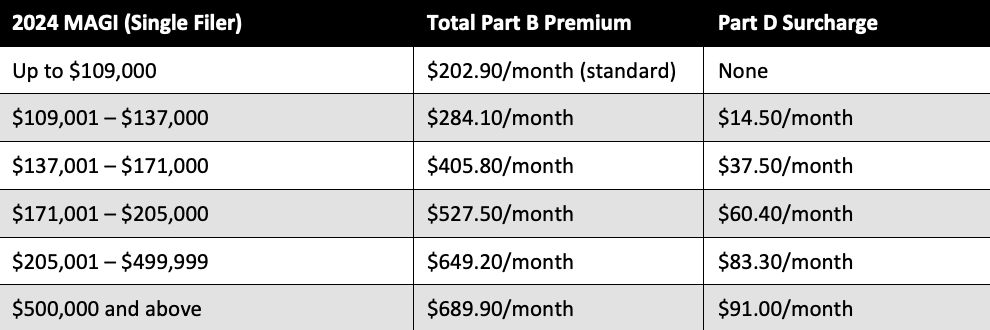
Source: Centers for Medicare & Medicaid Services (CMS), 2026. Figures shown per person/per month. MAGI is based on 2024 federal tax return.
Married Filing Jointly
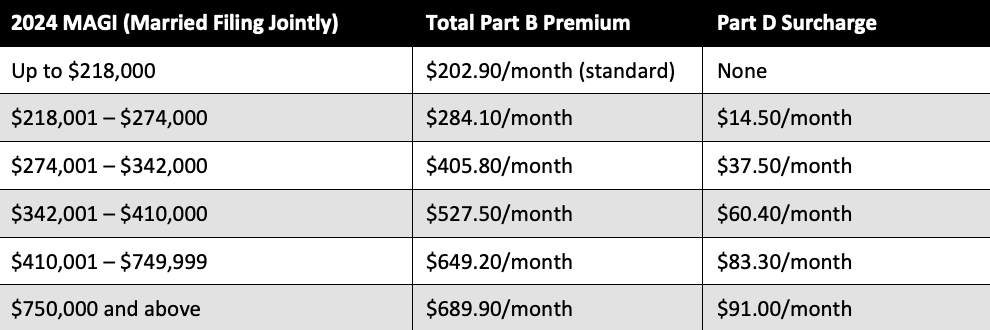
Source: Centers for Medicare & Medicaid Services (CMS), 2026. Figures shown per person/per month. MAGI is based on 2024 federal tax return.
The cliff effect means that a modest income spike, such as a one-time Roth conversion or the sale of a property, could push you into a higher bracket.
What Counts as Income
MAGI for IRMAA purposes is broader than many people expect. It includes everything in your adjusted gross income plus any tax-exempt interest. In practice, that includes:
Wages and salaries
Taxable Social Security benefits
Withdrawals from traditional IRAs and 401(k)s
Required minimum distributions (RMDs)
Roth conversions
Capital gains
Dividends and taxable interest income
Rental income
Pension and annuity income
Tax-exempt interest, such as municipal bond interest
That last item surprises many people. Municipal bond interest doesn’t appear in taxable income, but the IRS adds it back when calculating MAGI for IRMAA purposes.
RMDs deserve particular attention. Your required start age is 73 if you were born between 1951 and 1959, or 75 if you were born in 1960 or later. Once you reach that age, you are required to take distributions from traditional retirement accounts each year. Those distributions count toward your MAGI. For retirees with substantial pre-tax savings, RMDs alone can push income above an IRMAA threshold even in years when other income is modest.
Strategies to Consider
IRMAA isn’t always avoidable, but it can often be managed with proactive planning. A few approaches worth discussing with your financial advisor:
Roth conversions before Medicare eligibility. Converting a portion of your traditional IRA to a Roth IRA in the years before you turn 65 raises taxable income in the short term. But over time, it lowers future RMDs and creates tax-free income in retirement. Spreading conversions across multiple years could help you stay below IRMAA thresholds when your premiums matter most. (To learn more about Roth accounts, see our blog “How a Roth IRA May Benefit You Regardless of Your Age.”)
Qualified charitable distributions (QCDs). If you’re 70½ or older and charitably inclined, a QCD allows you to transfer up to $111,000 annually (the 2026 limit) directly from your IRA to a qualified charity. The distribution satisfies your RMD requirement for the year but isn’t included in your taxable income, which means it doesn’t raise your MAGI.
Managing one-time income events. Large income spikes from selling appreciated investments or real estate can push you into a higher IRMAA tier. Thoughtful timing and offsetting gains with losses where possible can help limit the impact.
Balancing your income sources. Drawing income from Roth accounts, taxable brokerage accounts, and traditional retirement accounts in a coordinated way can give you more control over what shows up as income in any given year. For more on a coordinated distribution plan, see our blog “Which Accounts Should You Tap First in Retirement?”
If Your Situation Has Changed
Because IRMAA is based on income from two years ago, some retirees find themselves paying a surcharge that no longer reflects their current picture. A retirement, job loss, divorce, or death of a spouse can all substantially change what a household earns.
In those cases, you may be able to make a request to reduce your IRMAA. The SSA allows you to request a new initial determination if you’ve experienced a qualifying life-changing event, using Form SSA-44. If approved, your IRMAA may be recalculated based on more recent income.
What to Do Next
Medicare premiums are a real line item in any retirement budget, and IRMAA adds a layer of complexity that’s easy to overlook until it shows up on your bill. The income decisions you make in the years before and after you enroll in Medicare directly affect what you’ll pay for coverage.
If you’d like to talk through how your income plan intersects with Medicare costs, we’re glad to help. Reach out to schedule a complimentary discovery call.